
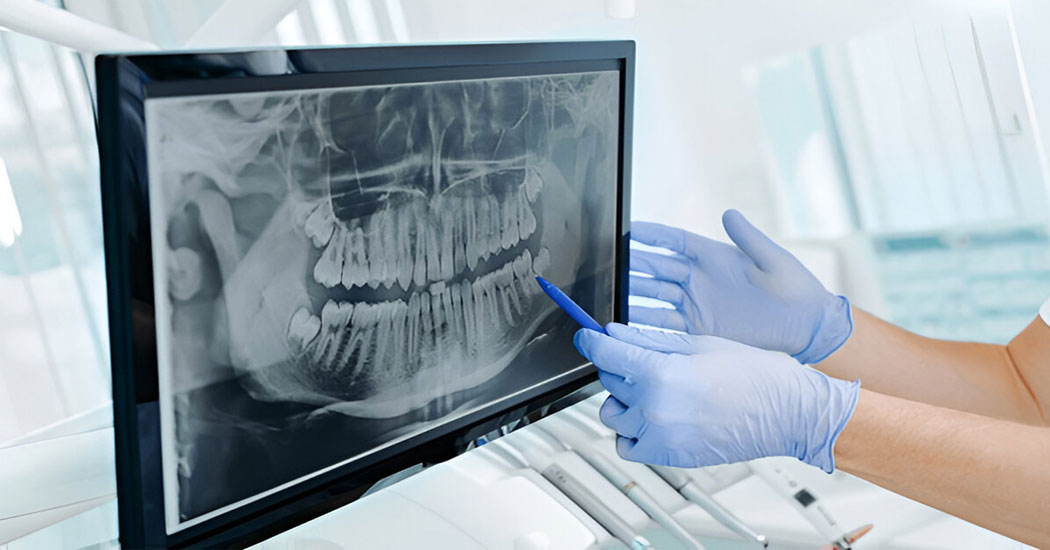
Many dental problems start where they cannot be seen in a normal check-up: between teeth, under old fillings, at the tip of a root or inside the jawbone. Dental radiology uses X-ray imaging to reveal these areas, so your dentist can diagnose accurately and plan treatment with confidence.
At Stavya Dental Hospital in Satellite, Ahmedabad, digital X-rays and full-mouth OPG (panoramic) imaging are available in-house. You do not need to visit a separate imaging centre, and your dentist can review the images with you during the same appointment.
Your dentist may recommend an X-ray if you have:
To look for deep decay, infection or a cracked tooth.
To check for an abscess or infection at the root tip.
To see the position of impacted teeth before extraction or disimpaction.
To measure bone levels around teeth affected by gum disease.
Before root canal treatment, dental implants or braces and orthodontics, imaging is essential for safe, precise planning.
To check for fractures of teeth, roots or bone.
We use digital sensors, which produce an image within seconds that can be enlarged on screen for a closer look.
A small sensor is placed inside the mouth to capture a detailed image of one or a few teeth, from crown to root tip. Ideal for checking root canals, infections and the bone around individual teeth.
An intraoral view of the back teeth with the upper and lower teeth together, used to detect decay between teeth that cannot be seen in a regular examination.
Taken from outside the mouth while the machine rotates around your head. It shows both jaws, all the teeth and the jaw joints in a single image, valuable for wisdom teeth, implant and orthodontic planning.
Close-up photographs of your teeth and gums. It uses no radiation and helps you see exactly what your dentist sees, such as cracks, worn fillings or plaque build-up.
Your dentist may use one or both, depending on what needs to be checked.
| Feature | Intraoral X-ray (IOPA) | OPG (panoramic) |
|---|---|---|
| What it shows | One or a few teeth in fine detail, including the root tip | Both jaws, all teeth, the jaw joints and nearby structures |
| How it is taken | Small sensor placed inside the mouth | Machine rotates around the head; nothing inside the mouth except a bite guide |
| Best for | Cavities, root canal treatment, a single painful tooth | Wisdom teeth, implant and orthodontic planning, full-mouth overview |
| Comfort | Quick and simple, though the sensor can be uncomfortable for people with a strong gag reflex | Suits people with a strong gag reflex or limited mouth opening |
Detailed views of teeth, bone and surrounding tissues reveal problems that are not visible during a clinical examination.
Precise information allows a plan tailored to your individual needs.
Knowing the shape of roots, the position of nerves and the bone available helps treatment go smoothly.
An accurate diagnosis can reduce the number of appointments and avoid unnecessary procedures.
Cavities, bone loss, infections, cysts and impacted teeth can be found early, when treatment is usually simpler.
Digital sensors typically need less radiation than older film X-rays, and images are ready in seconds.
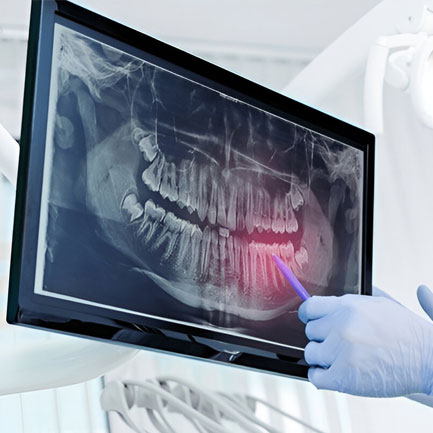
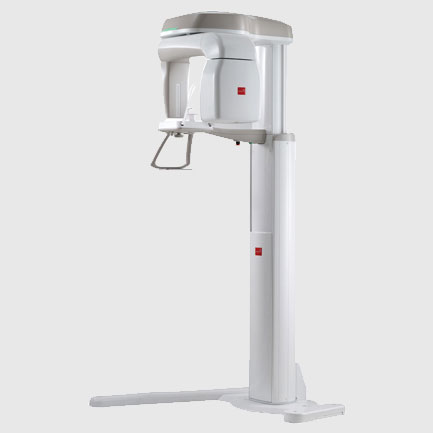
OPG (orthopantomography), a panoramic dental X-ray technique, offers several advantages for both diagnosis and patient comfort:
Dental X-rays use very low levels of radiation. We follow simple, well-established principles to keep your exposure as low as reasonably possible:
Pregnant or planning a pregnancy? Always tell our team before any X-ray. Dental X-rays are generally postponed during pregnancy unless they are needed urgently.
Tell the team if you are or might be pregnant. You will be asked to remove glasses, earrings, necklaces, hairpins and any removable dentures or braces that could appear on the image.
For an intraoral X-ray, a small sensor is placed gently in your mouth and held for a moment. For an OPG, you stand or sit in the machine, bite lightly on a guide and stay still while the arm moves around your head.
Digital images appear on screen almost immediately. Your dentist will explain what the X-ray shows and discuss any treatment you may need.
After your X-ray: no recovery time is needed and you can eat, drink and return to normal activities straight away. Keep a copy or record of your X-rays and mention them at future visits, as this can help avoid repeat imaging.
Digital X-rays and OPG at our own clinic, alongside intraoral cameras and an intraoral scanner.
Images are reviewed by our dentists, a team that includes an orthodontist (Dr. Krishna Ranpura), an endodontist (Dr. Suhani Pandya) and an oral surgeon (Dr. Ranil Patel).
ISO 9001:2015 certified, with a family dental practice legacy dating back to 1977 and strict sterilisation protocols.
Located on 132 ft Ring Road in Satellite, convenient for patients from Vastrapur, Shyamal, Jodhpur, Prahladnagar and Bodakdev.
If you have tooth pain, swelling or a treatment planned, an X-ray can give your dentist the full picture. Imaging is done in-house, so you can see and discuss your results during the same visit.
Yes. Dental X-rays use very low levels of radiation, and digital X-rays typically need less radiation than older film X-rays. We take X-rays only when they are needed and use protective measures to keep exposure as low as possible.
It depends on your age, oral health and risk of decay or gum disease. Some patients need check-up X-rays every year or two, while others need them less often. Your dentist will recommend X-rays only when they will help your diagnosis or treatment.
X-rays help detect cavities between teeth and under fillings, infections at the root tips, bone loss from gum disease, impacted or missing teeth, cysts and fractures. Many of these are not visible during a regular examination.
No. Dental X-rays are painless and take only a few minutes. An OPG is taken from outside the mouth, so it is comfortable even for people with a strong gag reflex.
A regular intraoral X-ray shows one or a few teeth in fine detail. An OPG is a panoramic image of both jaws, all teeth and the jaw joints in one picture. Your dentist may use one or both depending on what needs to be checked.
Dental X-rays are generally postponed during pregnancy unless they are needed urgently, in which case protective shielding is used. Always tell our team if you are or might be pregnant.
Yes. Children's X-rays are taken only when needed, for example to check for hidden cavities or how the permanent teeth are developing, and digital imaging keeps the dose very low.
The cost depends on the type and number of images needed for your case. Our team will explain what is required and the cost after your examination, before the X-ray is taken.
Still have a question? Our team is happy to help.
Call +91 89803 95039All rights reserved 2026 © Stavya Dental Hospital
